Thursday, January 21, 2021

Bayesian Inference


Statistical Inference

Statistical inference is the process of analyzing the result and making conclusions from data subject to random variation.

In Simple,

There is an unknown quantity that we would like to estimate. We get some data. From the data, we estimate the desired quantity. There are two major approaches to this problem:

Frequentist (classical) Inference

Bayesian Inference

Bayesian inference is a method of statistical inference  in which Bayes' theorem is used to update the probability for a hypothesis as more evidence or information becomes available.

In the Bayesian approach the unknown quantity Θ is assumed to be a random variable, and we assume that we have some initial guess about the distribution of Θ. After observing the data, we update the distribution of Θ using Bayes' Rule.

Bayesian Inference is an application of Bayes Theorem.


Tuesday, January 19, 2021

Red- Black Tree (M2.1)

Binary Search Tree is a node-based binary tree data structure which has the following properties:

  • The left sub tree of a node contains only nodes with keys lesser than the node’s key.
  • The right sub tree of a node contains only nodes with keys greater than the node’s key.
  • The left and right sub tree each must also be a binary search tree.

A red-black tree is a binary search tree (self balancing) with one extra bit of storage per node: its color, which can be either RED or BLACK .

By constraining the node colors on any simple path from the root to a leaf, red-black trees ensure that no such path is more than twice as long as any other, so that the tree is approximately balanced.

These colors are used to ensure that the tree remains balanced during insertions and deletions. Although the balance of the tree is not perfect, it is good enough to reduce the searching time and maintain it around O(log n) time, where n is the total number of elements in the tree.

Each node of the tree contains the attributes color, key, left, right, and p. 

If a child or the parent of a node does not exist, the corresponding pointer attribute of the node contains the value NIL. We shall regard these NIL s as being pointers to leaves (external nodes) of the binary search tree and the normal, key-bearing nodes as being internal nodes of the tree.
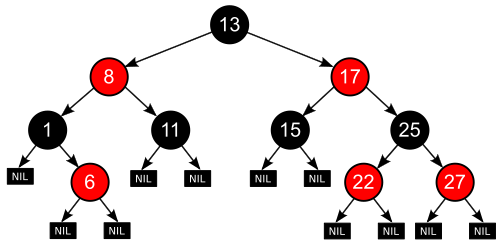

Diagram of binary tree. The black root node has two red children and four black grandchildren. The child nodes of the grandchildren are black nil pointers or red nodes with black nil pointers. 

A red-black tree is a binary tree that satisfies the following red-black properties:
1. Every node is either red or black.
2. The root is black.
3. Every leaf ( NIL ) is black.
4. If a node is red, then both its children are black.
5. For each node, all simple paths from the node to descendant leaves contain the same number of black nodes. 

Why Red-Black Trees?

Most of the BST operations (e.g., search, max, min, insert, delete.. etc) take O(h) time where h is the height of the BST. The cost of these operations may become O(n) for a skewed Binary tree. If we make sure that the height of the tree remains O(log n) after every insertion and deletion, then we can guarantee an upper bound of O(log n) for all these operations. The height of a Red-Black tree is always O(log n) where n is the number of nodes in the tree. 

Comparison with AVL Tree:( Is RB tree is more balanced than any other trees??

AVL tree is a self-balancing Binary Search Tree (BST) where the difference between heights of left and right sub trees cannot be more than one for all nodes.

The AVL trees are more balanced compared to Red-Black Trees, but they may cause more rotations during insertion and deletion. So if your application involves frequent insertions and deletions, then Red-Black trees should be preferred. And if the insertions and deletions are less frequent and search is a more frequent operation, then AVL tree should be preferred over Red-Black Tree.

General Insertion Algorithm

In a Red Black Tree, every new node must be inserted with color RED. The insertion
operation in Red Black Tree is similar to insertion operation in Binary Search Tree. But it is
inserted with a color property. After every insertion operation, we need to check all the
properties of Red Black Tree. If all the properties are satisfied then we go to next operation
otherwise we need to perform following operation to make it Red Black Tree.
Recolor
Rotation followed by Recolor 

 
The insertion operation in Red Black tree is performed using following steps...

  1. Check whether tree is Empty. 
  2. If tree is Empty then insert the newNode as Root node with color Black and exit from the operation.  
  3. If tree is not Empty then insert the newNode as a leaf node with Red color.  
  4. If the parent of newNode is Black then exit from the operation.  
  5. If the parent of newNode is Red then check the color of parent node's sibling of newNode.  
  6. If it is Black or NULL node then make a suitable Rotation and Recolor it.  
  7. If it is Red colored node then perform Recolor and Recheck it. Repeat the same until tree becomes Red Black Tree.

Fixing nodes:

  1. If a node is red at the root, change it to black.
  2. If the new node is red, and its parent is black you don't need to do anything.
  3. If a new node is red and its parent is red, what you do depends on colour of sibling of the parent
    • if the sibling of the parent is black, a rotation needs to be performed
    • if the sibling of the parent is red, a color swap with grandparent must be performed

Wednesday, December 30, 2020

Parallel and Distributed Databases/Database System Architectures (M2)

Parallel Database

  •  The parallel database is a system in which multiple processors execute and run queries simultaneously.
  • In a parallel database, we can use thousands of small processors.

Advantages of parallel databases

  • Improved Performance of the processing of data.
  • Increased data processing speed by using multiple resources such as CPUs and disks in parallel.
  • High Availability:- the same data is stored at multiple locations
  • Increases Reliability:- even of data site fails execution can continue as other copy of data are available.

Distributed Database


Data are often generated and stored on different database systems, and there is a need to execute queries and update transactions across multiple databases. This need led to the development of distributed database systems.

A distributed database is a collection of multiple interconnected databases, which are spread physically across various locations that communicate via a computer network.
  • Modular Development: If we want to expand the same system on different locations then we just need to add nodes to the current network and these nodes do not interrupt the current network functionalities.
  • Increases Reliability: If one node on a network fails then its work can be distributed between other nodes on the network, failing of one node does not stop the system.
  • Improves Performance: a small database is always easy to handle compared to a large database, so in the distributed database, a large database is distributed into small database across various locations which are easy to handle with better performance.
  • Increase Availability: failure of one node does not affect data availability as data can be obtained from various other nodes on the network.
  • Faster Response: the data is available locally so data retrieval becomes efficient.


Database System Architectures

  • Centralized and Client-Server Architectures
  • Server System Architectures
  • Parallel Systems
  • Distributed Systems

Centralized Database Systems

  • Centralized database systems are those that run on a single computer system.
  • They are widely used for enterprise-scale applications.
  • There are two ways in which computers are used: as single-user systems and as multiuser systems.
A typical single-user system is a system used by a single person, usually with only one
processor (usually with multiple cores), and one or two disks.

A typical multiuser system, on the other hand, has multiple disks, a large amount of memory, and multiple processors. Such systems serve a large number of users who are connected to the system remotely, and they are called server systems.

Database systems designed for single-user systems usually do not provide many of the facilities that a multiuser database provides.

The systems that not support SQL and may instead provide an API for data access. Such database systems are referred to as embedded databases since they are usually designed to be linked to a single application program and are accessible only from that application.

Multiuser database systems support the full transactional features. Such databases are usually designed as servers, which service requests received from application programs; the requests could be in the form of SQL queries or they could be requests for retrieving, storing, or updating data specified using an API.

Most general-purpose computer systems in use today have a few multicore processors (typically one to four), with each multicore processor having a few cores. Main memory is shared across all the processors in a general-purpose computer system. Parallelism with such a small number of cores, and with shared memory, is referred to as coarse-grained parallelism.

Databases running on coarse-grained parallel machines traditionally did not at-
tempt to partition a single query among the processors; instead, they ran each query
on a single processor, allowing multiple queries to run concurrently. Thus, such systems support a higher throughput; that is, they allow a greater number of transactions
to run per second.

In contrast, machines with fine-grained parallelism have a large number of processors, and database systems running on such machines attempt to parallelize single tasks (queries, for example) submitted by users.

Client-Server System
Server systems satisfy requests generated at m client systems.
Database functionality can be broadly divided into two parts :
Front-end
Back-end

Advantages of replacing mainframes with networks of workstations or personal
computers connected to back-end server machines:

better functionality for the cost

flexibility in locating resources and expanding facilities

better user interfaces

easier maintenance

Server System Architectures

Server systems can be broadly categorized as transaction servers and data servers.

# Transaction-server systems

- also called query-server systems, provide an interface to which clients can send requests to perform an action, in response to which they execute the action and send back results to the client.

Usually, client machines ship transactions to the server systems, where those transactions are executed, and results are shipped back to clients that are in charge of displaying the data. 

Requests may be specified through the use of SQL or through a specialized application program interface.


Transaction server systems consists of multiple processes accessing data
in shared memory.

The processes that form part of the database system include:
  • Server processes: These are processes that receive user queries (transactions), execute them, and send the results back. The queries may be submitted to the server processes from a user interface, or from a user process running embedded SQL, or via JDBC, ODBC, or similar protocols.
  • Lock manager process: This process implements lock manager functionality, which includes lock grant, lock release, and deadlock detection.
  • Database writer process: There are one or more processes that output modified buffer blocks back to disk continuously.
  • Log writer process: This process outputs log records from the log record buffer to stable storage. Server processes simply add log records to the log record buffer in shared memory, and if a log force is required, they request the log writer process to output log records (recall that a log force causes the log contents in memory to be output to stable storage).
  • Checkpoint process: This process performs periodic checkpoints.
  • Process monitor process: This process monitors other processes, and if any of them fails, it takes recovery actions for the process, such as aborting any transaction being executed by the failed process and then restarting the process.
The shared memory contains all shared data, such as:

  • Buffer pool.
  • Lock table.
  • Log buffer, containing log records waiting to be output to the log on stable storage.
  • Cached query plans, which can be reused if the same query is submitted again.

To ensure that no two processes are accessing the same data structure at the same time, databases systems implement mutual exclusion using either,

  • Operating system semaphores
  • Atomic instructions such as test-and-set or compare-and-swap, which are supported by the computer hardware.

 # Data-server systems 

- allow clients to interact with the servers by making requests to read or update data, in units such as files, pages, or objects.

For example, file servers provide a file-system interface where clients can create, update, read, and delete files. 

Data servers are used in local area networks where:
  • There is a high-speed connection between the clients and the server.
  • The client machines are having comparatively more processing power.
  • Tasks to be executed are computing-intensive.
In such an environment, the server machine sends data to the client machines to perform all processing at the client machine and then the client sends that data back to the server machine.

Data servers for database systems offer much more functionality; they support units of data such as pages, tuples, or objects that are smaller than a file. They provide indexing facilities for data, and they provide transaction facilities so that the data are never left in an inconsistent state if a client machine or process fails. The term data item to refer to tuples, objects, files, and documents. We also use the terms data server and data storage system interchangeably. Data servers support communication of entire data items.

Data servers in earlier generations of storage systems supported a concept called
page shipping, where the unit of communication is a database page that may potentially
contain multiple data items. Page shipping is not used today, since storage systems do
not expose the underlying storage layout to clients.

Caching at Clients
The time cost of communication between a client application and a server is high compared to that of a local memory reference.

Following issues decide the time cost of communication between client and server.
  • Data Shipping- {Page-Shipping versus Item-Shipping}: Units of communication for data are the page or an item (tuple or an object). Data can be fetched by fetching the page or single item (tuple or object).
  • Locks: Locks are usually granted by the server for data item/page that it ships client machine.

The time to send a message over a network, and get a response back, called the network round-trip time, or network latency, As a result, applications running at the client's adopt several optimization strategies to reduce the effects of network latency.

The optimization strategies include the following:
  • Prefetching- Fetching items even before they are requested.
  • Data caching-  Data that are shipped to a client on behalf of a transaction can be cached at the client within the scope of a single transaction. Data can be cached even after the transaction completes, allowing successive transactions at the same client to make use of the cached data. However, cache coherency is an issue.
  • Lock caching
  • Adaptive lock granularity
Lock de-escalation is a way of adaptively decreasing the lock granularity if there
is higher contention.

Parallel Systems

Parallel systems improve processing and I/O speeds by using a large number of com-
puters in parallel.

In parallel processing, many operations are performed simultaneously, in which the computational steps are performed sequentially. 

A coarse-grain parallel machine consists of a small number of powerful processors; a massively parallel or fine-grain parallel machine uses thousands of smaller processors.

Measures of Performance for Parallel Systems

There are two main measures of the performance of a database system: 
(1) throughput, the number of tasks that can be completed in a given time interval.
(2) response time, the amount of time it takes to complete a single task from the time it is submitted. 

A system that processes a large number of small transactions can improve throughput by
processing many transactions in parallel. A system that processes large transactions can improve response time as well as throughput by performing subtasks of each transaction in parallel.

Two important issues in studying parallelism are speedup and scaleup. Running a
given task in less time by increasing the degree of parallelism is called speedup. Handling larger tasks by increasing the degree of parallelism is called scaleup.

Speedup

A fixed-sized problem executing on a small system is given to an N-times larger system. i.e Speedup is the execution of a task in less time by the increasing the degree of parallelism.


Two kinds of scaleup are relevant in parallel database systems, depending on how the size of the task is measured:

  • In batch scaleup, the size of the database increases, and the tasks are large jobs whose runtime depends on the size of the database.
  • In transaction scaleup, the rate at which transactions are submitted to the database increases, and the size of the database increases proportionally to the transaction rate. This kind of scaleup is what is relevant in transaction-processing systems where the transactions are small updates.
Scaleup is usually the more important metric for measuring the efficiency of parallel database systems. The goal of parallelism in database systems is usually to make sure that the database system can continue to perform at an acceptable speed, even as the size of the database and the number of transactions increases.

Several factors work against an efficient parallel operation and can diminish both
speedup and scaleup.
  • Sequential computation- Start-up costs
  • Interference
  • Skew
Interconnection Networks
Parallel systems consist of a set of components (processors, memory, and disks) that
can communicate with each other via an interconnection network.
Commonly used types of interconnection networks:
  • Bus. All the system components can send data on and receive data from a single communication bus.
  • Ring. The components are nodes arranged in a ring (circle), and each node is connected to its two adjacent nodes in the ring.
  • Mesh. The components are nodes in a grid, and each component connects to all its adjacent components in the grid.
  • Hypercube. The components are numbered in binary, and a component is connected to another if the binary representations of their numbers differ in exactly one bit. Thus, each of the n components is connected to log(n) other components. In a hypercube interconnection, a message from a component can reach any other component by going through at most log(n) links.
Parallel Database Architectures

There are several architectural models for parallel machines.
  • Shared memory. All the processors share a common memory
  • Shared disk. A set of nodes that share a common set of disks; each node has its own processor and memory. Shared-disk systems are sometimes called clusters.
  • Shared nothing. A set of nodes that share neither a common memory nor common disk.
  • Hierarchical. This model is a hybrid of the preceding three architectures. This model is the most widely used today.
Distributed Systems

In a distributed database system, the database is stored on nodes located at geographically separated sites. 

The nodes in a distributed system communicate with one another through various communication media, such as high-speed private networks or the internet. They do not share the main memory or disks.


The main differences between shared-nothing parallel databases and distributed
databases include the following:
----------------


In a distributed database system, we differentiate between local and global transactions.

A local transaction is one that accesses data only from nodes where the transaction was initiated.
A global transaction, on the other hand, is one that either accesses data in a node different from the one at which the transaction was initiated, or accesses data in several different nodes.

Distributed databases that are built by integrating existing database systems have somewhat different characteristics.

Sharing data. The major advantage in building a distributed database system is the provision of an environment where users at one site may be able to access the data residing at other sites.
Autonomy. The primary advantage of sharing data using data distribution is that each site can retain a degree of control over data that are stored locally. In a centralized system, the database administrator of the central site controls the database. In a distributed system, there is a global database administrator responsible for the entire system.

Types:

In a homogeneous distributed database system, nodes share a common global
schema, all nodes run the same distributed database-management software and the nodes actively cooperate in processing transactions and queries.

However, in many cases, a distributed database has to be constructed by linking
together multiple already-existing database systems, each with its own schema and possibly running different database-management software. The sites may not be aware of
one another, and they may provide only limited facilities for cooperation in query and
transaction processing. Such systems are sometimes called federated database systems
or heterogeneous distributed database systems.

Nodes in a distributed database communicate over wide-area networks ( WAN ).

Disadvantage:
  • Added complexity required to ensure proper coordination among sites.
  • Software development cost.
  • Greater potential for bugs.
  • Increased processing overhead.

Saturday, December 26, 2020

Query optimization in Centralized Systems

 The optimal access path is determined after the alternative access paths are derived for the relational algebra expression. This chapter focus on query optimization in a centralized system.

Query processing for a centralized system is done to achieve:

  • The response time of a query is minimized.
  • The system throughput is maximized
  • The memory and storage used for processing are reduced.
  • Parallelism is increased.

Steps for Query Optimization

There are three steps for query optimization. They are -

Step 1 − Query Tree Generation

A relational algebra expression is represented by a tree data structure known as a query tree. Leaf nodes represent the tables of the query. The internal nodes represent the relational algebra operations and the complete query is represented by a root.

When the operand table is made available, the internal node is executed. The result table replaces the node and the process is continued until the result table replaces the root node.

Example 1

The query considered is as follows:

πEmpID(σEName="ArunKumar"(EMPLOYEE))

The query tree appears as follows:


Step 2 − Query Plan Generation

The query plan is prepared once the query tree is generated. All the operations of the query tree are included with access paths which are known as query plan. The relational operations on the performance of the tree are specified by the access paths. For instance, the access path for a selection operation provides information on the use of B+ tree index.

The information about the intermediate tables that are required to be passed from one operator to another is provided by a query plan. The information about the usage of temporary tables, combining the operations is provided by the query plan.

Step 3− Code Generation

The final step of query optimization is the generation of the code. The type of the underlying operating system determines the form of the query. The results are produced by running the query code thus generated by the Execution Manager.

Different approaches/algorithms to Query Optimization


Heuristic Based Optimization
Semantic Query Optimization


Query Processing and Query optimization

Query Processing includes translations on high-level Queries into low-level expressions that can be used at the physical level of the file system, query optimization and actual execution of the query to get the actual result.

In Simple, Query Processing is the activity performed in extracting data from the database. 

Textbook Based:

A query expressed in a high-level query language such as SQL must first be scanned, parsed, and validated. 

The scanner identifies the query tokens—such as SQL keywords, attribute names, and relation names—that appear in the text of the query, whereas the parser checks the query syntax to determine whether it is formulated according to the syntax rules (rules of grammar) of the query language.

 The query must also be validated by checking that all attribute and relation names are valid and semantically meaningful names in the schema of the particular database being queried. 

An internal representation of the query is then created, usually as a tree data structure called a query tree. It is also possible to rep-resent the query using a graph data structure called a query graph. 

The DBMS must then devise an execution strategy or query plan for retrieving the results of the query from the database files. A query typically has many possible execution strategies, and the process of choosing a suitable one for processing a query is known as query optimization.

Query processing has various steps for fetching the data from the database. The steps involved are:

  • Parsing and translation
  • Optimization
  • Evaluation


Parsing and translation

Before processing a query, a computer system needs to translate the query, The translation process in query processing is similar to the parser of a query. When a user executes any query, for generating the internal form of the query, the parser in the system checks the syntax of the query, verifies the name of the relation in the database, the tuple, and finally the required attribute value. The parser creates a tree of the query, known as 'parse-tree.' Further, translate it into the form of relational algebra. With this, it evenly replaces all the use of the views when used in the query. During parse call, the database performs the following checks- Syntax check, Semantic check and Shared pool check, after converting the query into relational algebra.

Syntax check

Semantic check

Shared Pool check

Hard Parse and Soft Parse –

If there is a fresh query and its hash code does not exist in the shared pool then that query has to pass through from the additional steps known as hard parsing otherwise if hash code exists then query does not pass through additional steps. It just passes directly to execution engine (refer detailed diagram). This is known as soft parsing.

Hard Parse includes following steps – Optimizer and Row source generation.

Query Optimization

It is a process in which multiple query execution plan for satisfying a query are examined and the most efficient query plan is satisfied for execution.
Database catalogue stores the execution plans and then optimizer pass the lowest cost plan for execution.

There are two main techniques that are employed during query optimization. 

The first technique is based on heuristic rules for ordering the operations in a query execution strategy. A heuristic is a rule that works well in most cases but is not guaranteed to work well in every case. The rules typically reorder the operations in a query tree.

The second technique involves systematically estimating the cost of different execution strategies and choosing the execution plan with the lowest cost estimate. These techniques are usually combined in a query optimizer.

Two internal representations of a query:

◼ Query Tree

◼ Query Graph

Row Source Generation –
The Row Source Generation is a software that receives an optimal execution plan from the optimizer and produces an iterative execution plan that is usable by the rest of the database. the iterative plan is the binary program that when executes by the SQL engine produces the result set.

Query Evaluation Plan

  • In order to fully evaluate a query, the system needs to construct a query evaluation plan.
  • The annotations in the evaluation plan may refer to the algorithms to be used for the particular index or the specific operations.
  • Such relational algebra with annotations is referred to as Evaluation Primitives. The evaluation primitives carry the instructions needed for the evaluation of the operation.
  • Thus, a query evaluation plan defines a sequence of primitive operations used for evaluating a query. The query evaluation plan is also referred to as the query execution plan.
  • A query execution engine is responsible for generating the output of the given query. It takes the query execution plan, executes it, and finally makes the output for the user query.